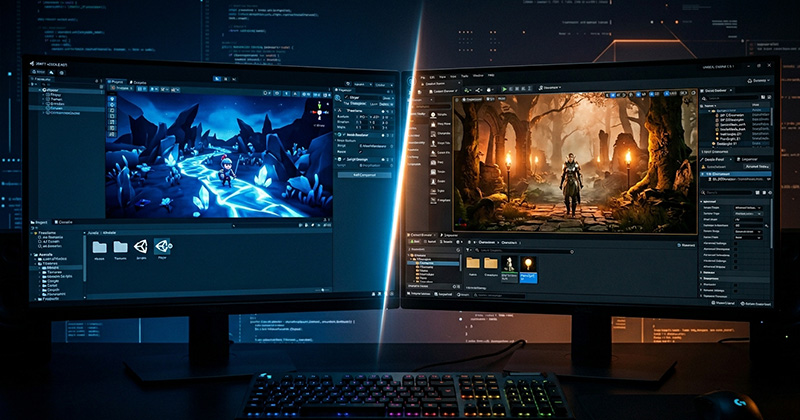
We have shipped titles in both Unity and Unreal. We have mid-project migrations from one to the other. We have had this conversation with every client who comes to us still undecided. Here is what we actually tell them.
First: The Fee Situation
Unity’s 2023 runtime fee announcement (since walked back and reframed) spooked a lot of studios into reconsidering their engine choice. That’s understandable. But making an engine decision purely on licence anxiety is a mistake. The fee changes were real, but so was Unity’s eventual response to industry pressure. The current Unity pricing is far more palatable than what was originally announced, and for most studios (especially pre-revenue) it is not the deciding factor.
The real decision is: which engine gives your specific team the best shot at shipping a great game?
Where Unity Wins
Unity has the best mobile toolchain in the industry. If you are building for iOS and Android (especially anything with casual, hyper-casual, or mid-core mechanics) Unity is the faster, leaner, better-supported choice. The Asset Store, the C# ecosystem, and the sheer volume of Unity developers available for hire all point in the same direction for mobile-first teams.
- Mobile performance: Better out-of-the-box profiling, lighter build sizes, faster iteration loops on device
- 2D toolset: Unity’s 2D workflow (Tilemap, Sprite Atlas, 2D Physics) is more mature than Unreal’s Paper2D
- Talent pool: Significantly more Unity developers available, especially in the mid-market salary range
- Asset Store: Enormous ecosystem of ready-made tools, plugins, and systems that save real time on smaller projects
- Prototyping speed: C# with MonoBehaviours is faster to iterate on than Unreal’s Blueprint + C++ split for most teams
Where Unreal Wins
If your game lives or dies on visual fidelity (open worlds, realistic environments, cinematic presentation) Unreal’s rendering pipeline is genuinely better. Nanite, Lumen, and the Chaos physics system give you capabilities that would take months to replicate in Unity’s HDRP. For PC and console-first titles where the art bar is high, Unreal is the correct choice.
- Visual quality ceiling: Nanite + Lumen gives you AAA lighting and geometry without the manual optimisation work
- Blueprint system: Unreal’s visual scripting is excellent for non-programmers and rapid prototyping of game logic
- Free until you ship: No seat licence cost; Epic takes 5% royalty after $1M revenue (with specific terms)
- Multiplayer framework: Unreal’s built-in networking and dedicated server support is better suited to complex multiplayer games
- MetaHuman + Sequencer: For narrative-heavy games, the character and cinematic tools are class-leading
Side-by-Side
| Criteria | Unity | Unreal |
|---|---|---|
| Mobile development | ✓ Stronger | Possible but heavier |
| 2D games | ✓ Much stronger | Limited tooling |
| 3D visual fidelity | Good (HDRP/URP) | ✓ Excellent (Nanite/Lumen) |
| Console/PC AAA | Achievable | ✓ Industry standard |
| Talent availability | ✓ Larger pool | Growing but smaller |
| Learning curve | ✓ Gentler | Steeper (C++ required at scale) |
| Asset ecosystem | ✓ Larger | Smaller but growing |
| Multiplayer (complex) | Requires more setup | ✓ Better framework |
| Licensing cost | Monthly seat + potential fees | ✓ Free until $1M revenue |
The Decision Framework
We use a simple filter with new clients:
- Is mobile your primary platform? If yes: Unity, full stop.
- Is 2D a significant part of the game? If yes: Unity.
- Is visual fidelity the primary selling point? If yes: Unreal.
- Does your team already have engine experience? Don’t switch unless the game genuinely demands it. A mid-project engine migration costs 3–6 months and morale you cannot afford to lose.
Our Recommendation
For the majority of studios we work with (mobile-first, mid-size teams, prototype-to-launch in under 18 months), Unity remains the right call in 2026. The fee concerns, while legitimate to track, do not outweigh the mobile toolchain advantage, the talent pool, and the faster iteration speed.
For studios building PC/console titles with a high visual bar, strong 3D requirements, and a team already comfortable in C++, Unreal is the right call. The rendering quality is real and the Blueprint system rewards the right kind of team.
“The best engine is the one your team ships with. A polished Unity game beats an abandoned Unreal project every time.” Nine Pixels internal dev review, 2024
If you are genuinely unsure, reach out. We run both engines in active production and can give you an honest opinion based on your specific brief.