We are an outsourcing studio. We have a vested interest in you choosing to outsource. So take this with the appropriate grain of salt, but also recognise that we have seen hundreds of clients make this decision, and we have seen both sides go badly wrong. Here is what we actually tell clients when they ask.
The Real Question Is Not Cost: It Is Control
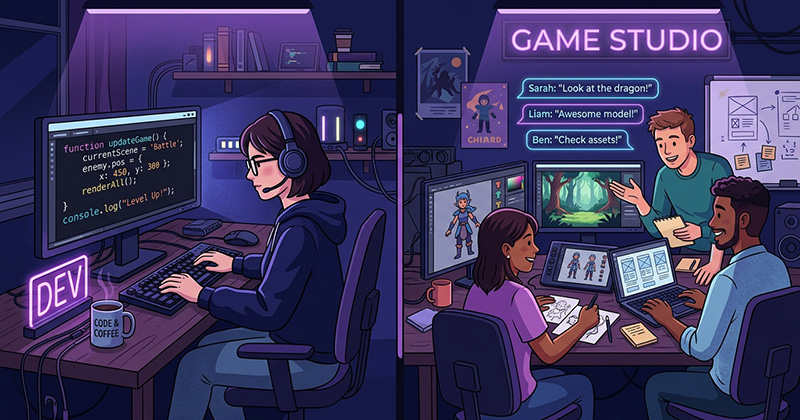
Most studios frame the build vs hire decision as a cost question. It is not. The real question is: how much control over the process do you need? Cost is a proxy for that. Building an internal team gives you total control over daily decisions, culture, and direction. Outsourcing trades some of that control for speed, specialisation, and flexibility. Neither is universally better. The right answer depends entirely on where you are in your studio’s development and what you are building.
The Hidden Costs of Building In-House
The quoted cost of an in-house developer is their salary. The true cost is 1.4–1.7x that number when you factor in employer taxes, benefits, equipment, office space (even in a hybrid model), HR overhead, recruitment cost (typically 15–25% of first-year salary via an agency), onboarding time (6–12 weeks before meaningful output), and management bandwidth. A £60k developer costs closer to £85–95k in total annual outlay.
Beyond the financial cost, in-house teams carry structural costs that compound over time:
- You own the hiring risk. If someone doesn’t work out, you are 3–6 months in before you know, and the replacement cycle starts again
- You own the skills gap problem. When your game pivots (and it will) your team’s existing specialisations may no longer match what you need
- You own the morale problem. A team that shipped one type of game for two years may resist pivoting to something very different
The Hidden Costs of Outsourcing
The quoted cost of an outsourced studio is the day rate or project fee. The true cost includes the management overhead of running an external team, which is higher than managing internal staff. Expect to spend 15–25% of an internal person’s time actively managing an outsourced engagement: setting context, reviewing deliverables, making decisions fast enough to not block the team. If that management resource doesn’t exist on your side, the engagement will underperform regardless of the studio’s quality.
The other outsourcing cost that gets underestimated is knowledge transfer at the end. If the outsourced team builds something and then leaves, and your internal team cannot maintain or extend it, you have created a dependency that costs you in the long run.
- 1.4–1.7x salary in total outlay
- 6–12 weeks to useful output
- You own the hiring risk
- Skills gaps compound over time
- Long-term institutional knowledge
- Full culture and process ownership
- Day rate + 15–25% management overhead
- Faster ramp-up if brief is clear
- Studio owns hiring/retention risk
- Knowledge transfer risk at end
- Less institutional context
- Flexibility to scale up or down
When Outsourcing Wins
Outsourcing is the right call when:
- You need a specific skill for a defined period. Unity expertise for a 9-month project, art production for a launch push, QA for pre-release: these are classic outsourcing use cases where hiring would leave you with costs you cannot justify after the need passes
- Speed to first build matters more than long-term team control. An external studio with existing processes and talent can ship a prototype in 8–12 weeks. Hiring and onboarding a team to do the same thing might take 4–6 months
- You are not yet sure what you need. Outsourcing is a good way to test whether a capability belongs in-house before making the hiring investment
When Building In-House Wins
Building internal capability is right when:
- The capability is your core competitive advantage. If your game’s success depends on a technical or creative edge that your competitors cannot replicate, that capability should be in-house and protected
- You are going to use the skill continuously for more than 18 months. At that point the economics of in-house generally start to favour building, especially at senior levels
- Culture and creative direction require tight alignment. Some types of work (narrative direction, art style development, core mechanic design) require deep immersion in the game’s intent that is hard to transfer to an external team efficiently
“The studios that use outsourcing best treat it like a force multiplier, not a cost cut. They have strong internal direction and use external teams to move faster, not to avoid building capability.” Rachel Nguyen, Head of Partnerships, Nine Pixels
The Short Answer
For most early-stage and mid-size studios: outsource the specialisms you need episodically, build the capabilities that define your studio long-term. The mistake is treating it as binary. The best studios do both simultaneously, with clear thinking about which category each capability falls into.
And if you are talking to us: we will tell you honestly if what you need is better served by an in-house hire. We are interested in long-term client relationships, not in selling engagements that are the wrong fit.