Most articles about the game development process read like a university lecture. Lots of phases, lots of diagrams, not much about what actually happens in practice. This is our version. The real process, based on the games we have shipped.
Step 1: Discovery and Scoping
Before a single line of code is written, we need to understand what we are building and why it should exist. This means getting clear on the core loop, the target audience, the platform, the monetisation model, and the rough scope. A good discovery phase saves months of pain later. A bad one means you build the wrong thing really well.
Discovery typically takes one to two weeks and results in a Game Design Document that everyone on the team agrees on. Not a 200-page spec. A clear, living document that answers the questions that matter.
Step 2: Prototype
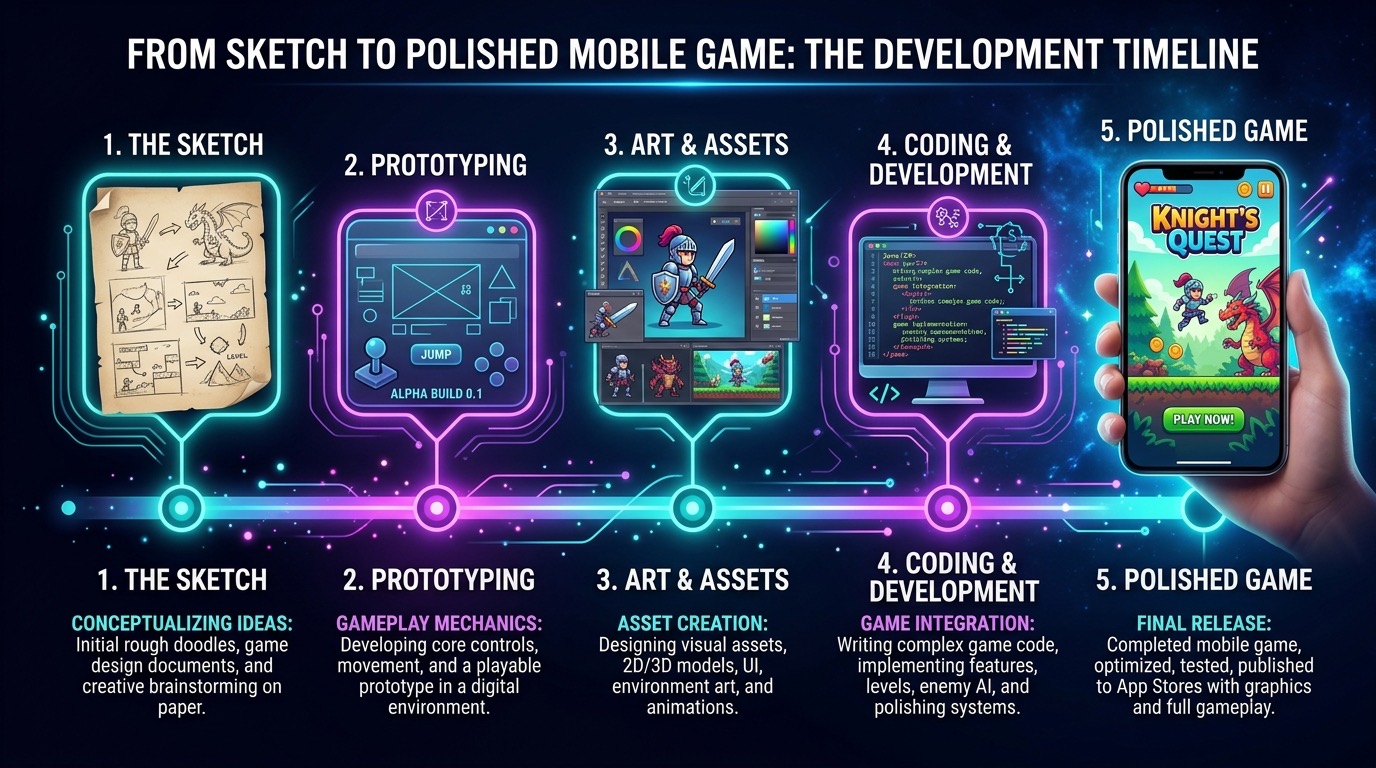
The prototype exists for one reason: to find out if the core game feel is actually fun. We build the minimum version of the core mechanic, strip everything else out, and play it. A lot. If it is not engaging in prototype form, adding art and sound will not save it.
This is also the cheapest stage to make big decisions. Changing the core mechanic in a prototype takes days. Changing it three months into production is painful and expensive. Prototype phase: two to four weeks.
Step 3: Concept and Art Direction
Once the prototype feels right, we define the visual identity of the game. This includes the art style, colour palette, character design direction, UI style, and the overall feel. We produce concept art and a small set of reference assets before committing to full production. This step prevents the most common and most costly problem in game development: building a thousand assets in the wrong style and having to redo them.
Step 4: Pre-Production
Pre-production is where the game gets fully designed on paper before it gets built in the engine. Level structures, progression systems, economy design, feature lists, technical architecture, and sprint planning all happen here. It is the least glamorous phase and one of the most important.
A project that skips proper pre-production almost always runs over time and over budget. The time you spend here pays back at a 5 to 1 ratio during production. Every decision made here is a production crisis avoided.
Step 5: Production
This is the main build phase. Developers, artists, and designers work in parallel sprints, usually two weeks long, with a working build reviewed at the end of each sprint. The goal is to have a playable, content-complete build by the end of production. Not polished. Not optimised. But complete.
Production is where scope creep does the most damage. Every “small addition” costs time. The discipline to hold the scope is what separates studios that ship from studios that do not.
Step 6: Alpha and Internal QA
The alpha build is the first version that gets systematically tested. QA engineers go through every feature, every platform, and every edge case looking for bugs, crashes, and anything that breaks the experience. On mobile, this also means testing across a wide range of devices. A game that runs beautifully on a Samsung Galaxy S24 may struggle on a three-year-old mid-range Android.
Step 7: Beta, Soft Launch, and Optimisation
Soft launch is one of the most underrated stages in mobile game development. Rather than going global immediately, we release to one or two smaller markets, typically Canada, Australia, or the Philippines, to gather real player data. We look at retention rates, session length, monetisation performance, and crash reports.
Step 8: Global Launch and Live Ops
Launch day is not the finish line. For a live service game, it is the starting gun. App Store and Google Play optimisation, launch marketing, user acquisition, community management, and the first few post-launch updates all happen in this phase. The games that succeed long-term are the ones that treat launch as the beginning of a product, not the end of a project.
How Long Does All of This Take?
- A hyper-casual game: two to four months
- A casual or mid-core game: five to nine months
- A story-driven or complex multiplayer game: twelve months or more
These are real ranges, not optimistic estimates. The variables that affect timing the most are scope discipline, feedback loop speed, and how quickly decisions get made.
We can take a project through all eight stages, or drop into any one of them. Talk to us about what the next step looks like for your project.