We looked at 40 hyper-casual titles that crossed the top 10 charts between 2022 and 2024. Not case studies. Actual data from store rankings, install velocity, and Day 1 retention benchmarks. Here is what they have in common, and why most attempts to copy them fail.
Trait 1: Instant Comprehension
Every chart-topping hyper-casual game passes what we call the “three-second rule”: someone who has never heard of the game should understand exactly what to do within three seconds of watching gameplay footage. If you need to explain the mechanic, it is not hyper-casual: it is something else. The mechanic should be visually self-evident from a single screenshot or a one-second video loop.
This is why so many hyper-casual concepts are re-skins or evolutions of existing mechanics rather than genuinely novel ideas. “Stack the objects”, “avoid the obstacles”, “match the colours”: these concepts transfer without explanation because players have pattern-matched them against something they already know.
Trait 2: Universal Frustration, Not Niche Skill
The best hyper-casual concepts are not about gaming skill, they are about universal human frustrations made interactive. Untangling things. Squeezing through gaps. Stacking precarious objects. Satisfying sorting. These resonate because they tap into experiences and anxieties that have nothing to do with being a gamer. A 60-year-old non-gamer and a 16-year-old hardcore player will both understand and feel the same instinctive reaction to a well-designed hyper-casual loop.
Trait 3: The Satisfying Fail State
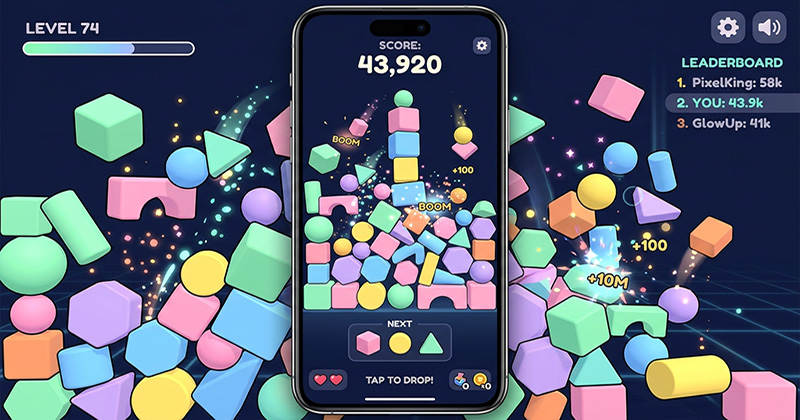
In mid-core and hardcore games, death is supposed to feel bad: it enforces consequence and creates tension. In hyper-casual, the fail state is part of the entertainment. Watching the stacked objects fall, the character squish against the wall, the carefully sorted pile collapse: this should be almost as satisfying as succeeding. The best hyper-casual fail states are shareable on their own. People screenshot and video-capture failures because they are visually interesting, not because they are embarrassing.
“In hyper-casual, the fail animation is a marketing asset. If it is not interesting to watch, you have designed the wrong fail state.” Tom Mills, Game Designer, Nine Pixels
Trait 4: The Loop Length Sweet Spot
Across the 40 titles we analysed, the median session length for the first play was 45–90 seconds. Not 10 seconds (too shallow to build attachment) and not 5 minutes (too long to be “just one more go”). The loop has to be short enough that players feel no friction picking it up, but long enough that they feel something when they lose.
More importantly: the second session should start within 30 seconds of the first ending. If there is any friction between “you lost” and “you’re playing again” (a loading screen, a menu, an ad that interrupts before the retry) you will lose a significant portion of players at that moment.
Trait 5: The Creative Concept Travels
The viral mechanism for hyper-casual is not paid UA, it is organic social sharing and TikTok-style content. The games that go viral are games that are visually interesting to watch someone else play. If your game only makes sense when you are playing it (if the experience doesn’t translate to a 15-second clip) you have a retention game, not a viral game. The mechanic should produce visually striking moments: dramatic near-misses, satisfying completions, funny failures.
What Does Not Work
Most hyper-casual failures share three characteristics:
- Too much game design: Adding complexity, branching paths, or skill trees to a hyper-casual concept does not make it better. It makes it mid-core without the depth that mid-core requires
- A theme that limits the audience: Hyper-casual needs universal appeal. Niche themes (fishing for fishing fans, football for football fans) work against the format’s strength, which is being immediately accessible to everyone
- Monetisation designed before retention: Most failed hyper-casual titles have either no meaningful monetisation (pure ad model with no IAP) or aggressive early IAP that kills retention before the game has a chance to earn anything meaningful
The Formula
Instant comprehension + universal frustration + satisfying fail state + short loop + videoable concept. All five. Not four out of five. Any one missing and the viral mechanism breaks.
The honest caveat: even with all five, most hyper-casual titles do not go viral. Luck and timing are real variables. But without all five, no amount of UA budget compensates. The formula is necessary, not sufficient.